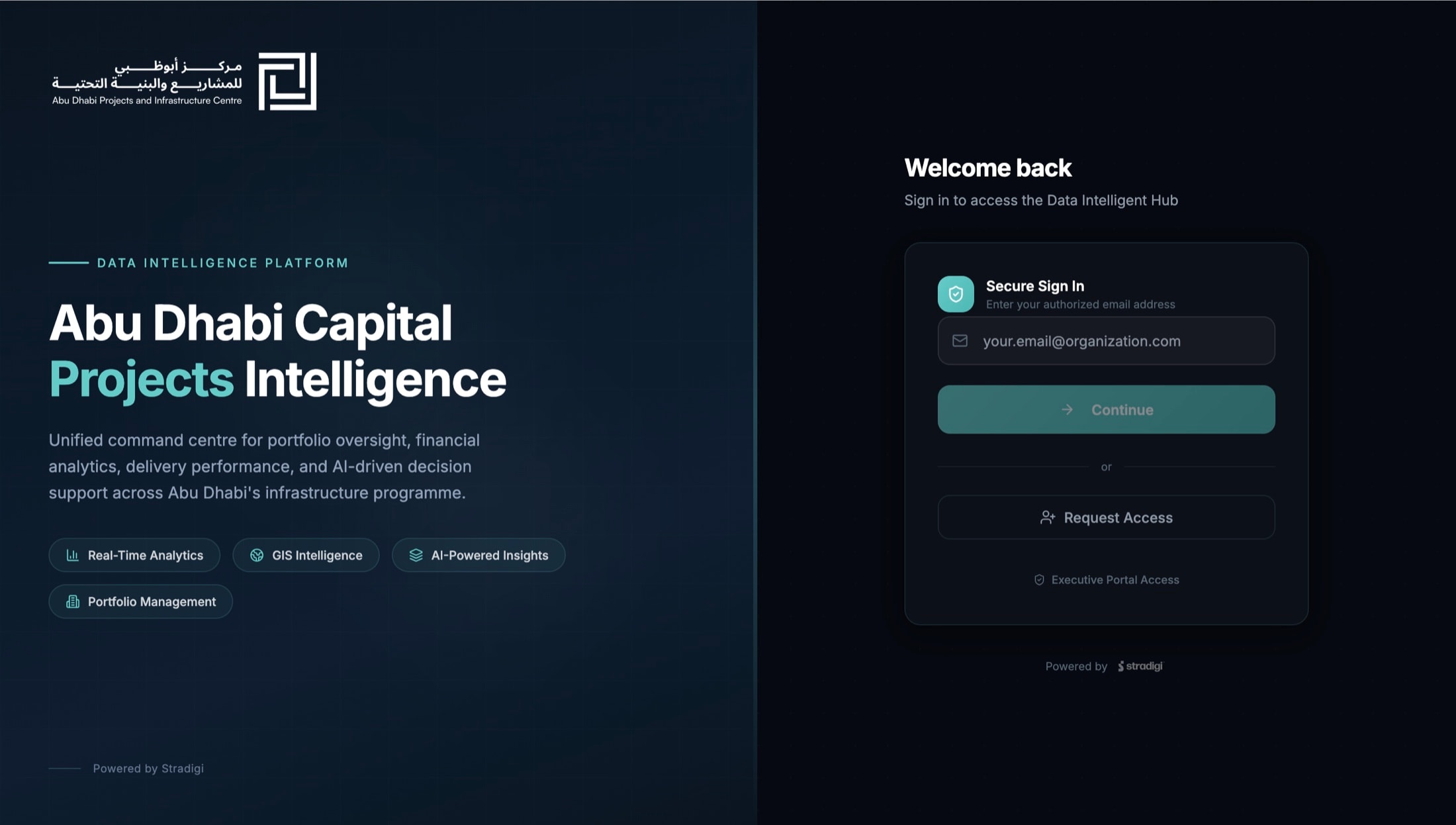
ADPIC iHUB
- Client
- Abu Dhabi Projects and Infrastructure Centre
- Role
- Architecture & direction
- Year
- 2026
The problem
Capital-projects data arrived from three separate enterprise systems, none of them under the client's control, each maintained by a different vendor on a different upgrade schedule. A single renamed field upstream could quietly corrupt the budget and delivery figures leadership uses to allocate capital — and nothing would visibly break until someone noticed the numbers looked wrong.
The approach
A fifty-four table model behind roughly 475 typed API procedures, and a schema-drift defence built in four layers: data contracts per source, staging tables that raw data lands in before promotion, structural fingerprinting with automated drift classification, and a field-mapping registry that absorbs safe renames. Ten distinct kinds of upstream change are classified by severity, from a harmless added field to a silently restructured nested object.
The outcome
Silent data corruption became a detected, classified and triaged event. Leadership reads one view of the portfolio instead of reconciling three systems by hand.
Built with
- TypeScript
- React
- tRPC
- MySQL
- Drizzle ORM
- Graph RAG
- LLM tool calling